Table of Contents
- Why Window Tint Matters in Birmingham
- How Automotive Window Film Works
- Common Types of Window Tint
- Heat and UV Protection Are Different Benefits
- Visibility, Glare, and Driving Safety
- Alabama Window Tint Rules
- Tint, Sensors, and Modern Vehicle Technology
- Choosing, Installing, and Caring for Tint
Birmingham drivers deal with bright summer sun, humid afternoons, sudden rain, and vehicles that often sit in uncovered workplace or apartment parking. Window tint can make daily driving more comfortable by reducing glare and helping manage cabin heat. It also works well as part of a broader exterior-care plan that may include ceramic coating for cars in Birmingham, AL, especially for vehicles exposed to sun, pollen, road grime, and changing weather.
The right film is not necessarily the darkest. A smart choice balances heat control, ultraviolet protection, clear visibility, legal compliance, vehicle technology, appearance, and budget. For a Birmingham commuter returning to a hot car after an eight-hour shift, those differences can be noticeable every day.
Why Window Tint Matters in Birmingham
Sunlight through untreated glass can create harsh glare on I-65, Highway 280, or neighborhood streets during early-morning and late-afternoon drives. It can also leave steering wheels, seats, and dashboard surfaces uncomfortably hot. Tint helps limit visible glare and solar energy entering the cabin, although it does not replace air conditioning, a windshield shade, or shaded parking.
Drivers comparing tints with other appearance upgrades may also search for automotive ceramic coating near me when they want help protecting painted surfaces from Birmingham’s outdoor conditions. These services address different areas of the vehicle. Tint focuses on glass, cabin comfort, and sunlight exposure, while coating is intended for exterior paint care.
How Automotive Window Film Works
Window film is a thin layer applied to the inside of automotive glass. Its performance is measured in several ways. Visible light transmission, often called VLT, describes how much light passes through the finished glass and film. Infrared rejection relates to heat-producing energy, while UV rejection describes the film’s ability to reduce ultraviolet radiation. Reflectance refers to the amount of light bounced away from the glass.
These figures are not interchangeable. A darker shade can reduce brightness, but a lighter high-performance film may reject more heat than a darker basic film. The UV window film used in vehicles can block more than 99 percent of UVA and UVB radiation when it meets appropriate performance standards. This matters because side, rear, and sunroof glass may not offer the same UVA protection as a laminated windshield.
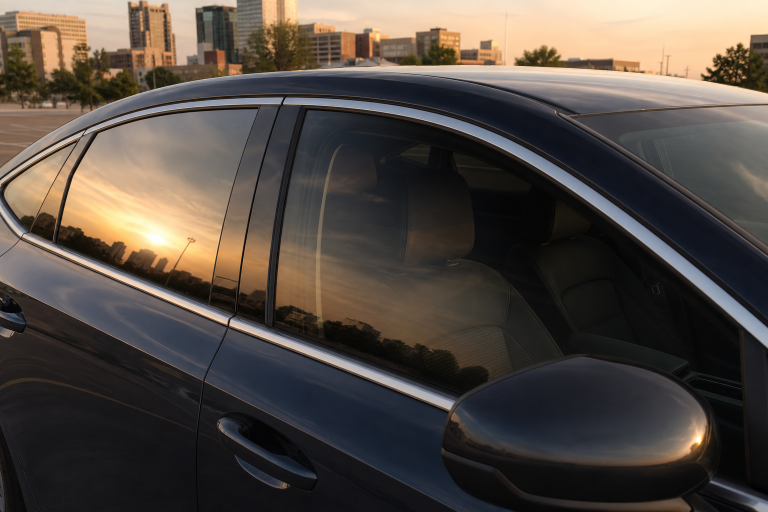
Common Types of Window Tint
- Dyed film: Often the lower-cost option. It can improve privacy and reduce glare, but lower-grade versions may fade or discolor sooner.
- Metalized film: Can reflect heat effectively, though metal content may interfere with some GPS, radio, mobile, or toll-tag signals.
- Carbon film: Usually provides a neutral, low-gloss appearance and a middle ground between basic price and heat performance.
- Ceramic film: Uses nonmetallic particles and can provide strong heat rejection without requiring extremely dark glass. It commonly costs more than entry-level film.
Heat and UV Protection Are Different Benefits
For Birmingham vehicles parked outdoors, heat rejection can make the cabin feel less punishing when the door first opens. UV reduction can also help limit fading and drying on dashboards, door panels, leather, fabric, and trim over time. Review the manufacturer’s spec sheet for total solar energy rejected, infrared performance, UV rejection, and VLT rather than relying on the film’s appearance alone.
A Quick Performance Check
- Choose VLT based on legal requirements and nighttime visibility.
- Compare heat-control claims using the same measurement across products.
- Confirm the stated UV protection applies to the exact film series and shade.
- Remember that clear or lightly tinted UV film may still offer meaningful protection.
Visibility, Glare, and Driving Safety
Privacy has limits. Very dark film can make it harder to spot pedestrians, cyclists, curbs, parked cars, and standing water after sunset or during Birmingham rainstorms. Windshields and front side windows deserve the most caution because they directly affect the driver’s view. Before installation, look through sample shades from inside a vehicle when possible, not only at display boards under indoor lighting.
Alabama Window Tint Rules
Current Alabama tinting regulations state that only the upper six inches of the front windshield may be tinted transparently. Passenger cars and station wagons must allow at least 32 percent light transmission on side and rear windows, with a 3 percent tolerance, and reflective material may not exceed 20 percent reflectance.
SUVs, trucks, vans, and recreational vehicles follow the same windshield and front-seat window limits. Still, a darker tint may be permitted on the rear window when federal manufacturing rules allow it. Alabama also requires a visible compliance label for qualifying tint, and medical waivers may be available for certain physician-certified conditions. Confirm the classification of the specific vehicle and obtain a post-installation light measurement.
Tint, Sensors, and Modern Vehicle Technology
Many late-model vehicles have windshield cameras, rain sensors, antenna elements, heads-up displays, or advanced driver-assistance equipment near the glass. Discuss these features before work begins. Nonmetallic film is often the safer option when signal interference is a concern, and film should not obstruct camera areas, sensor zones, or required driver visibility.
Choosing, Installing, and Caring for Tint
- Start with the goal. Decide whether heat reduction, UV protection, glare control, privacy, or appearance matters most.
- Confirm the legal limit. Account for factory glass and film together, not film shade alone.
- Review the exact product. Ask about warranty coverage, film construction, curing time, and signal compatibility.
- Inspect the finished work. Look for creases, large bubbles, contamination, poor edges, or windows that catch on seals.
- Use gentle maintenance. Wait for the recommended curing period, then clean with a microfiber cloth and ammonia-free glass cleaner.
Window tint is most useful when it matches the way a vehicle is actually used. For a Birmingham daily driver, a legally compliant film with strong heat control, reliable UV performance, and safe nighttime visibility can make commutes more comfortable without creating avoidable problems on the road.